
Criminal Cases in the DeKalb County Courts
DeKalb County criminal case records are divided by court role. General Sessions Court hears misdemeanors, handles warrants, and conducts the early steps in felony matters. A felony may move from a preliminary hearing to the grand jury and then into Criminal Court in Tennessee's 13th Judicial District. Circuit Court Clerk Susan L. Martin keeps the files for Circuit, Criminal, General Sessions, and Juvenile Courts. The clerk states that adult records are public, while juvenile records are excluded from ordinary public access.
City citations follow a different route. Smithville City Court at 104 East Main Street and Alexandria City Court at 102 High Street keep municipal and traffic matters. Neither city court is the felony trial court. The Clerk and Master handles Chancery work, and the County Clerk is also not the custodian of DeKalb County criminal court files. Knowing the court prevents a wrong-counter trip and makes a name or case-number request far more precise.
Room 201 Holds DeKalb Case Records
The main adult criminal-record counter is in Room 201 of the DeKalb County Courthouse, 1 Public Square, Smithville, TN 37166. The office is open Monday through Friday from 8:00 a.m. to 4:30 p.m. Call 615-597-5711 or fax 615-597-9919. Have the case number or participant name ready. For an older or closed DeKalb County court case, ask whether the file is held as paper, a scan, or an archived record and whether retrieval time is needed.
The official Circuit Court Clerk page shows how the clerk presents court services and docket access.

The clerk page reinforces that the local office, rather than a broad statewide database, is the point for an official DeKalb County docket, judgment, or certified copy.
DeKalb Circuit Court Clerk
1 Public Square, Room 201
Smithville, TN 37166
615-597-5711
Monday-Friday, 8:00 a.m.-4:30 p.m.
How to Search Case Records
There is no comprehensive official historical DeKalb County case-search portal. The clerk posts upcoming dockets and offers online payment links, but those tools do not replace a file search. Use the court level, participant name, approximate year, and case number when known. Then inspect the docket and request the disposition or judgment that answers the question.
- Identify the likely court. Use city court for a municipal citation, General Sessions for a misdemeanor or felony preliminary stage, and Criminal Court for a felony after indictment.
- Call the proper clerk with the participant name, approximate year, and case number if available. Ask for the court division and current status.
- Review the published upcoming docket when the matter is active. For older DeKalb County criminal cases, ask Room 201 to retrieve the official file.
- Read each charge and docket event separately. A complaint, indictment, plea, dismissal, judgment, and sentence answer different questions.
- Request a plain or certified copy of the final disposition or judgment. Compare it with TORIS only when checking whether TBI received the outcome.
Because the DeKalb clerk route is a navigation and counter search rather than a full party-name portal, these are the useful lookup fields documented in the local research.
| Field Label | Type | Required | Notes |
|---|---|---|---|
| Participant name | Phone or counter request | Primary route | Use the full name and confirm spelling |
| Case or docket number | Identifier | If known | Fastest way to isolate one file |
| Approximate year | Date range | Helpful | Narrows older and archived files |
| Court or division | Category | Helpful | City, General Sessions, Criminal, or Circuit |
| Charge or event date | Text/date | Optional | Helps distinguish people with the same name |
DeKalb Web Dockets Are Provisional
The clerk's online material is useful for an upcoming setting, but the clerk warns that web information is provisional. Printed official documents control legal rights. A person may see a date or payment link online without seeing every motion, order, or final charge outcome. That gap matters most when initial charges changed or a case ended through a plea, dismissal, acquittal, or diversion.
The DeKalb court forms page also illustrates the limits of online material and directs users back to the responsible court process.

Forms can help identify a filing route, but they are not the case record and do not prove that a form was filed, accepted, or decided.
Note: Ask for the signed disposition or judgment when a web docket and a later background record seem to conflict.
What the Case File Shows
A DeKalb County criminal case file follows the prosecution, not just the arrest. It may contain the charging paper, settings, motions, attorney entries, plea, disposition, judgment, sentence, bond or capias activity, and financial entries. Request the final signed record if the purpose is to confirm how a charge ended. A docket is a timeline; it may abbreviate an event without carrying the full text of the filed order.
| Case Number & Court | Identifies the file, division, and court that handled the matter. |
|---|---|
| Charging Document | May be a complaint, information, or grand-jury indictment stating the filed charge. |
| Docket Entries | List settings, filings, motions, pleas, orders, and other events in date order. |
| Hearing Dates | Show scheduled date, time, judge, and event type when recorded. |
| Disposition & Judgment | State whether each charge ended in conviction, dismissal, acquittal, or another result. |
| Sentence & Conditions | May record confinement, probation, costs, restitution, and related court orders. |
Which DeKalb Court Has the File
General Sessions and Criminal Court do not hold duplicate versions of one fixed case. General Sessions can dispose of a misdemeanor and can also conduct the early proceeding in a felony matter. If a felony is bound over and the grand jury returns a true bill, the indictment proceeds in Criminal Court. Smithville and Alexandria city courts mainly handle municipal or traffic matters rather than felony trials.
The Tennessee court directory for DeKalb County shows the local court jurisdictions in one official source.
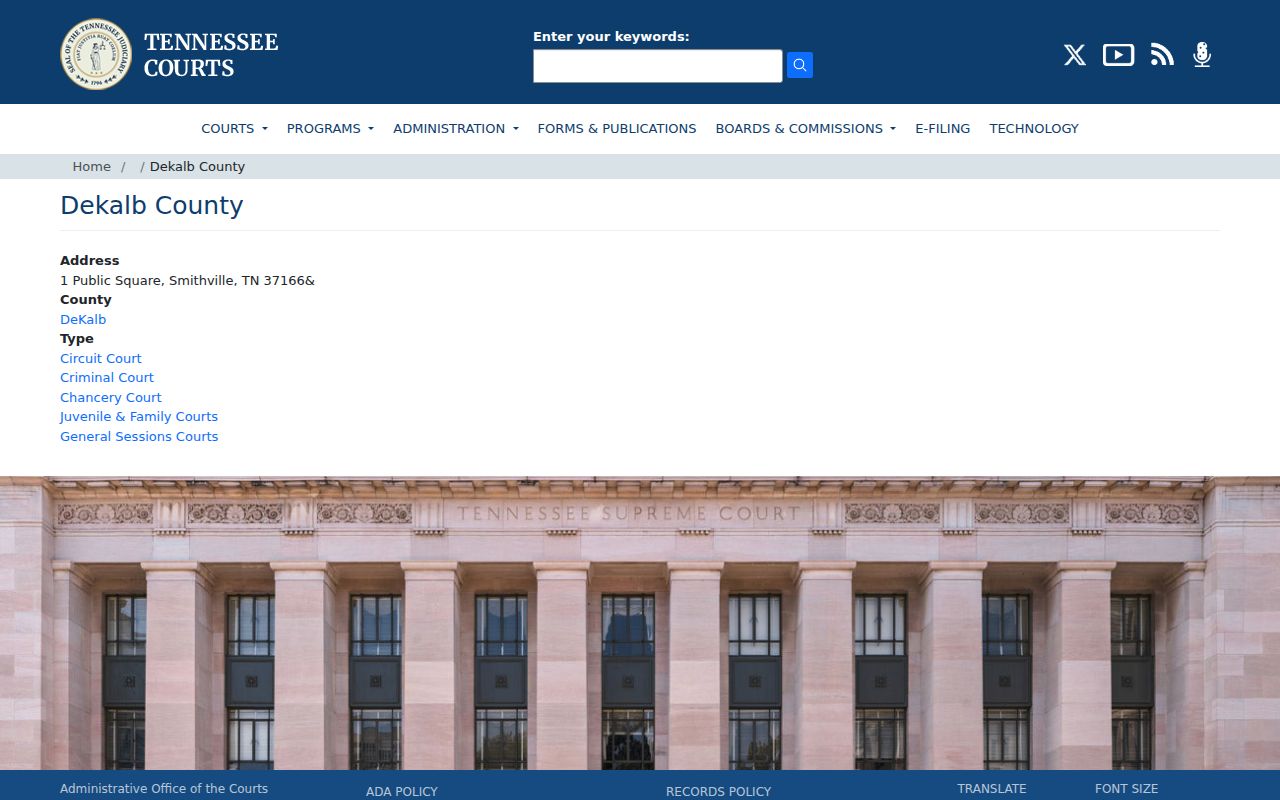
The directory helps identify the right court, while the local clerk remains the custodian for the actual DeKalb County criminal case record.
When the first record is a city citation, call the city clerk before going to the county courthouse. Smithville's clerk can be reached at 615-597-4745, and Alexandria's at 615-529-2700. If the matter became a state misdemeanor or felony, ask whether General Sessions or Criminal Court received it. This distinction is more reliable than guessing from the arresting agency alone.
Stages of a Criminal Case
A case can begin with an arrest, citation, or sworn complaint. General Sessions addresses the initial appearance, bond, and misdemeanor path. For a felony, a preliminary hearing may lead to grand-jury review. A true bill creates an indictment in Criminal Court. Arraignment follows, then discovery, motions, and either a plea or trial. Judgment, sentencing, later motions, and an appeal may add more entries. No fixed DeKalb timeline was published, so a docket should be read by actual event dates rather than assumed deadlines.
Case flow: Charges Filed › Arraignment › Pretrial › Plea or Trial › Disposition › Sentencing
The official courthouse information page documents screening and practical court-entry rules for people attending proceedings.

Every entrant is screened, and the published jury guidance does not promise that electronic devices may be used during a hearing or record inspection.
A felony process may also include the 13th Judicial District prosecutor and the DeKalb grand jury. Grand-jury work is secret, but a returned indictment generally becomes part of the adult court file once filed. The clerk's 2026 public notice identifies an August 4 grand-jury term and cites T.C.A. §40-12-105. That notice is a calendar item, not a party-name index.
Note: Grand-jury secrecy protects its work, but a returned indictment generally enters the adult court file after filing.
Read DeKalb Criminal Docket Terms
A short docket entry can change the meaning of a DeKalb County case search. Read the term, then request the order behind it. A disposition applies charge by charge, so one file can contain more than one result.
- Capias
- A court writ directing arrest, often after a missed appearance or failure to comply.
- Nolle prosequi
- The prosecutor's formal decision not to continue a charge.
- Disposition
- The outcome of a charge, such as conviction, dismissal, or acquittal.
- Judgment
- The court's formal record of the result and, when applicable, the sentence.
- Indictment
- A grand jury's formal felony accusation after a true bill.
The 13th Judicial District prosecutor profile identifies the district that presents felony cases and works with the grand jury.
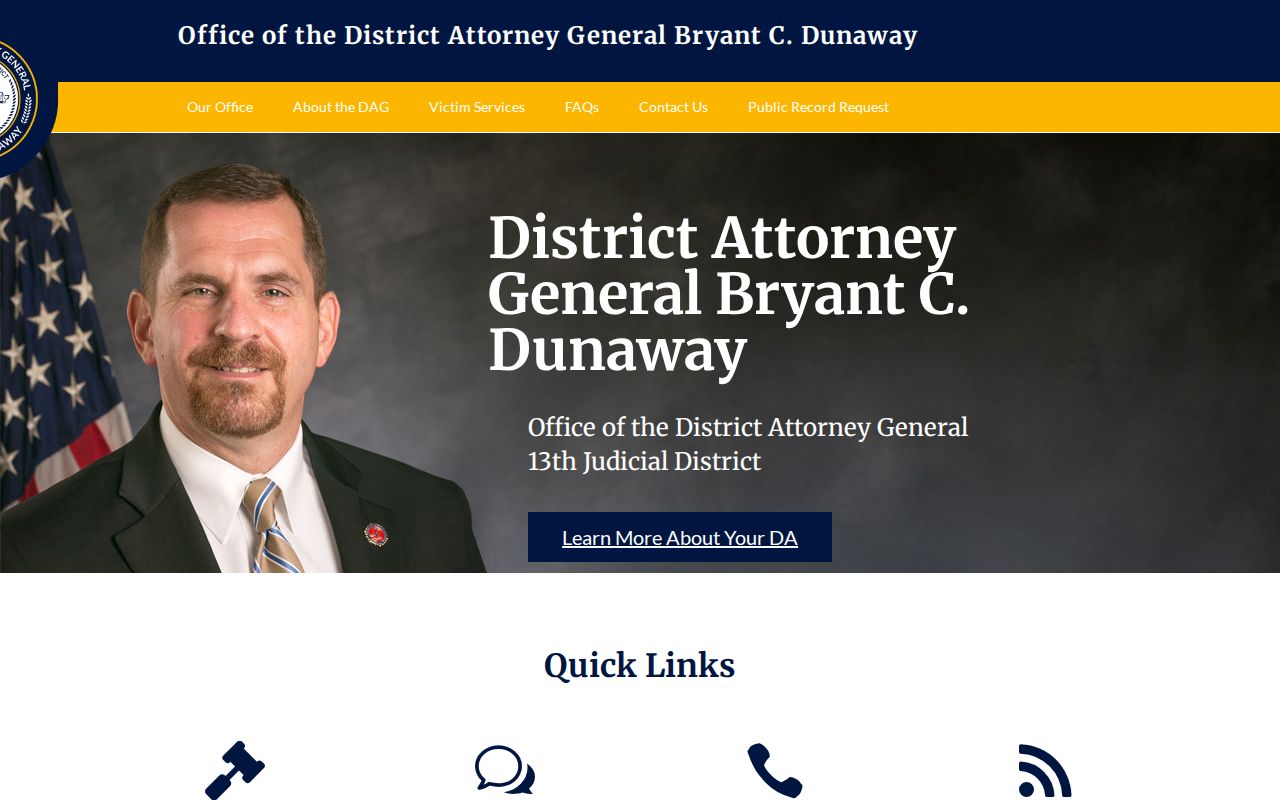
The district spans DeKalb and six other counties, but DeKalb filings and judgments remain with the local clerk.
Other docket words describe release or supervision rather than guilt. A bond sets financial or legal conditions for release and appearance. Probation is court-ordered community supervision, while parole is conditional release under state authority. Restitution is a court-ordered payment tied to loss. Read each term in the signed order because a brief docket label may omit conditions and dates.
Access & Restrictions
The Tennessee Public Records Act supports inspection and copying of public records by Tennessee citizens unless another law makes the material confidential. Tennessee Supreme Court Rule 34 governs court-record access and redaction. DeKalb's clerk expressly treats adult files as public and juvenile records as the exception. Sealed or expunged material, protected victim or minor data, Social Security numbers, medical information, and security-sensitive content should not be expected in a public copy.
If a DeKalb County criminal case does not appear in a web docket, call Room 201. Absence from a provisional page does not prove that no file exists. Ask the clerk to search by participant name, case number, and year, then request the releasable docket and final order. A certified disposition is stronger proof of the local outcome than a name-based repository match.
A public-record request must identify the records with enough detail for the custodian to locate them. The office need not create a new report or conduct an unlimited search. When part of a file is exempt, ask for the redacted releasable portion and the legal basis for withholding the rest. The clerk's statement about public adult records does not cancel specific confidentiality rules.
Fix a Missing DeKalb Disposition
A TORIS result may show a fingerprint-supported arrest without the later DeKalb County disposition. That does not override the courthouse file. Obtain the signed final order from the clerk and contact TBI or TORIS about the missing outcome. The clerk and prosecutor report dispositions, diversions, and expungements electronically through Tennessee FlexCheck, but reporting lag or an incomplete transmission can leave the state summary behind the court record.
When a qualifying case was dismissed, an expungement under T.C.A. §40-32-101 begins in the court where the DeKalb charge ended. A dismissal alone does not assure that each arrest, booking, court, and TBI trace vanishes at once. Keep a certified copy of the signed order and follow up with each affected custodian.
The statewide expungement order asks for court, county, case number, defendant, offense, arresting agency, arrest date, disposition, and statutory ground. It provides signature lines for the defendant or attorney, district attorney, and judge. Once signed and any required costs are addressed, the clerk distributes it to affected agencies. Separate systems may not process the order on the same day.
Note: A TORIS name match is not fingerprint identity verification and does not replace the certified DeKalb court judgment.